
Where Are the Elephanta Caves?
Elephanta Island, known locally as Gharapuri or “City of Caves,” sits in Mumbai Harbour approximately 11 kilometres east of the Gateway of India. There are no roads and no bridges to the island. The only way to reach it is by ferry, and that crossing across the Arabian Sea is part of the experience itself. Once you step off at the jetty, you have two options: walk roughly one kilometre along a flat, market-lined path to the base of the hill, or take the island’s toy train for a short ride to the same point. Both routes end at the staircase, 120 steps up to the cave complex, which is steady and manageable for most visitors. The caves are open Tuesday to Sunday, 9 AM to 5 PM. They are closed every Monday.The History of Elephanta Caves
Who Built the Elephanta Caves?
No inscription inside the caves names their builder. That mystery is part of what makes the site compelling. These are some of the most ambitious stone carvings in Indian history, and the record of who commissioned them is simply gone. What scholars do know: the main cave complex was most likely built during the Kalachuri dynasty, in the reign of King Krishnaraja, around the mid-6th century CE. The evidence comes from architectural style, numismatic data, and comparisons with other dated cave sites. Some historians also attribute later patronage to the Chalukyas and Rashtrakutas. The island’s sacred history runs even deeper. Buddhist stupas on the eastern hill predate the Hindu caves by several centuries, with archaeological remains pointing to Buddhist occupation as early as the 2nd century BCE. Long before the Shaivite temples were carved, Gharapuri was already a place people came to for something beyond the ordinary.How Did Elephanta Get Its Name?
For centuries, locals called this island Gharapuri. The name Elephanta came later, and not from the caves themselves. When Portuguese explorers arrived in 1534 and took control of the island from the Gujarat Sultanate, they found a massive stone elephant statue near the old landing site. They named the island “Elefante,” which became Elephanta over time. That original sculpture no longer stands on the island. Damaged during an attempt to ship it to England, it was eventually reassembled and moved to Jijamata Udyan, a garden and zoo in the Byculla neighbourhood of Mumbai, where it stands today. Worth knowing before you arrive expecting to find it at the caves.From Active Temple to UNESCO World Heritage Site
The caves were an active Hindu place of worship for centuries. That changed when the Portuguese established their base on the island. Worship stopped, and the sculptures suffered. Bullet marks from soldiers who used the cave as a firing range are still visible on some panels today. Some historians also attribute deliberate damage to the Marathas in the 17th century, though that remains debated. British India officials made the first formal effort to preserve the site in 1909, placing it under the Ancient Monuments Preservation Act. The Indian government undertook significant restoration work in the 1970s to stabilise the structures. In 1987, UNESCO designated Elephanta Caves a World Heritage Site under two criteria: as one of the greatest examples of Indian art, and as the most magnificent achievement in the history of rock-cut architecture in western India. Today the Archaeological Survey of India (ASI) manages and maintains the site. In 2024, Google Arts & Culture and CyArk launched a 3D interactive virtual tour of Cave 1, built from 197 laser scans and over 6,500 photographs, for anyone who wants to explore it before visiting in person.What to See Inside the Elephanta Caves?
Cave 1: The Great Cave
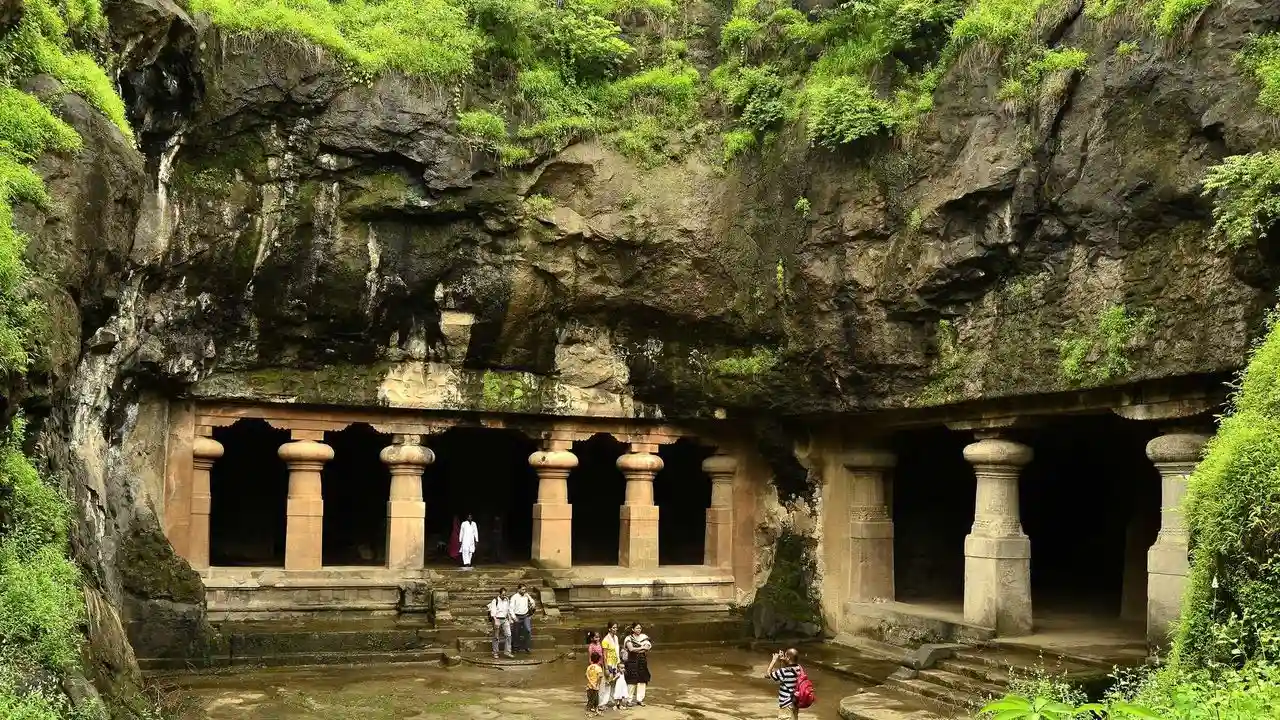
Cave 1 is where you’ll spend most of your time, and rightly so. The hall is 39 metres deep with rows of columns carved from the same basalt rock face as the ceiling above them. Three entrances let in daylight from north, east, and west. The architecture draws from the Buddhist Vihara style, a monastery layout, but repurposes it entirely as a Shaivite temple. The Trimurti Sadashiva is the centrepiece, set into the south wall opposite the main entrance. At 6.27 metres (just over 20 feet), it is a three-headed bust of Shiva carved in high relief from the basalt. Each face holds a different cosmic identity: the serene, meditative Tatpurusha at the centre; the fearsome, turbulent Aghora on the left; and the gentle, feminine Vamadeva on the right. Together they represent creation, preservation, and destruction. Stand in front of it long enough and it stops looking like a sculpture and starts feeling like a statement. The Nataraja panel on the western wall shows Shiva as the Lord of Dance, dynamic, multi-armed, mid-motion. It is among the more damaged panels but still carries real force. Ardhanarishvara appears to the east of the Trimurti. The carving depicts Shiva and Parvati as one unified body, half male and half female, representing the inseparability of masculine and feminine energy in the universe. The lower half of the panel is largely destroyed, but the upper half, where the detail survives, is extraordinary. The Gangadhara panel is one of the few in Cave 1 where the lower portions remain intact. It shows Shiva bringing the Ganges down from the heavens to serve humanity, while Parvati stands beside him. The detail in the surrounding figures is meticulous. Look carefully at some of the pillar bases and statue faces. The bullet marks are real, not restoration damage or natural wear. They are a record of what happened here in the 16th and 17th centuries, and they make the fact that the Trimurti survived all of it feel quietly remarkable.Caves 2 to 7: The Rest of the Island
Caves 2 through 5 cluster on Cannon Hill to the southeast of Cave 1. Most are in various states of ruin. Cave 2 was significantly restored in the 1970s and has four square pillars and two small cells; Cave 4 retains a lingam shrine at its back. These are worth a walk-through if time allows, though neither the detail nor the condition approaches Cave 1. Caves 6 and 7 sit on the eastern Stupa Hill, connected to the western hill by a walkway. Cave 6, also called the Sitabai cave temple, was converted into a church during Portuguese rule. Little of the original decoration remains, but a frieze of carved lion figures survives. Cave 7 holds only a small verandah. The Buddhist caves and stupa mounds nearby date back to the 2nd century BCE, predating the Hindu complex by over seven centuries. They’re modest in appearance but significant as evidence of how long this island has held meaning for people. Before or after the caves, spend 15 minutes in the on-site museum near the ticket counter. It holds artefacts related to Elephanta and places the caves within the wider tradition of rock-cut architecture across India.Best Time to Visit Elephanta Caves
October to February
This is the best window. The weather is cooler, the Arabian Sea is calm, and the 120-step climb to the caves is pleasant rather than punishing. The cave interiors stay naturally cool even when temperatures rise outside, but the causeway between the jetty and the hill gets exposed sun from mid-morning onwards, so arriving early makes a genuine difference. If your trip falls in February, check the dates for the Elephanta Festival, a two-day cultural event organised by the Maharashtra Tourism Development Corporation (MTDC) held annually at the caves. It features live classical dance performances (Kathak, Bharatanatyam, Odissi, Kuchipudi, Manipuri), Hindustani and Carnatic music, theatre, and folk performances by the local Koli fishing community. The Trimurti is dramatically lit for the occasion, and the atmosphere inside the pillared Great Cave is unlike anything you’ll find on a standard visit day.March to May
Trip during this season is doable but demanding. The causeway from the jetty to the hill staircase has little shade, and by late morning the combination of open sun and humidity makes the walk noticeably harder than in winter months. Take the earliest ferry, carry at least two litres of water per person, and plan your return before noon.June to September (monsoon season)
Ferry services to Elephanta are suspended during peak monsoon due to rough seas and official safety restrictions. Ferries genuinely do not run on many days between June and August, and the ASI site can close when conditions are unsafe. If you’re visiting Mumbai during this period, plan Elephanta for a day when the weather is clearly stable and confirm ferry service is running before you head to the Gateway of India.Ferry Timings and Getting to the Gateway of India
The first ferry to Elephanta departs at 9 AM from the Gateway of India. Ferries run approximately every 30 minutes throughout the day. The crossing takes about an hour. The last return ferry from Elephanta Island departs at 5:30 PM, so keep this in mind when planning your time on the island.Ferries and caves are both closed on Mondays.
To reach the Gateway of India from within Mumbai, take a local train to Churchgate or CST (both are the closest railway stations), then a short cab, auto-rickshaw, or walk to the waterfront. From most parts of South and Central Mumbai, a direct taxi or ride-hailing app gets you there in 20 to 40 minutes depending on traffic.Entry Fees and What to Expect on Arrival
Visiting the Elephanta Caves is simple if you know the basic costs and what to expect on arrival. From entry tickets and ferry access to walking paths and food stalls, a little preparation can make your visit more comfortable.- International tourist entry fee: ₹600
- Indian & SAARC visitors entry fee: ₹40
- Children below 15 years: Free entry
- Additional charges: ₹10 village fee and ₹25 videography fee
- Still photography is free
- Toy train from jetty to hill base: ₹10
- The train covers only the flat 1 km stretch, not the staircase
- Food stalls and small eateries are available on the island
- Carry your own water, especially during summer months